Whether used in roadside billboards to sell you sketchy supplements you probably don’t need or intricately applied through blood, sweat, and pastels to convey an artist’s deepest emotions — Design is everywhere. In general, the concept of “design” is consistently overlooked, yet vastly underestimated. At the risk of sounding like the cliché hook to a grade school essay, the Webster Dictionary defines “design” as “the arrangement of elements or details in a product or work of art.” Expanding further, and for the purposes of this blog post, I believe this quote from the late Steve Jobs best summarizes “design” as a whole…
‘Design is a funny word. Some people think design means how it looks. But of course, if you dig deeper, it’s really how it works.’
The 7 Components of Design
As outlined by Steven Bradley in The 7 Components Of Design, seven elements (similar to digital storytelling) are integral to design:
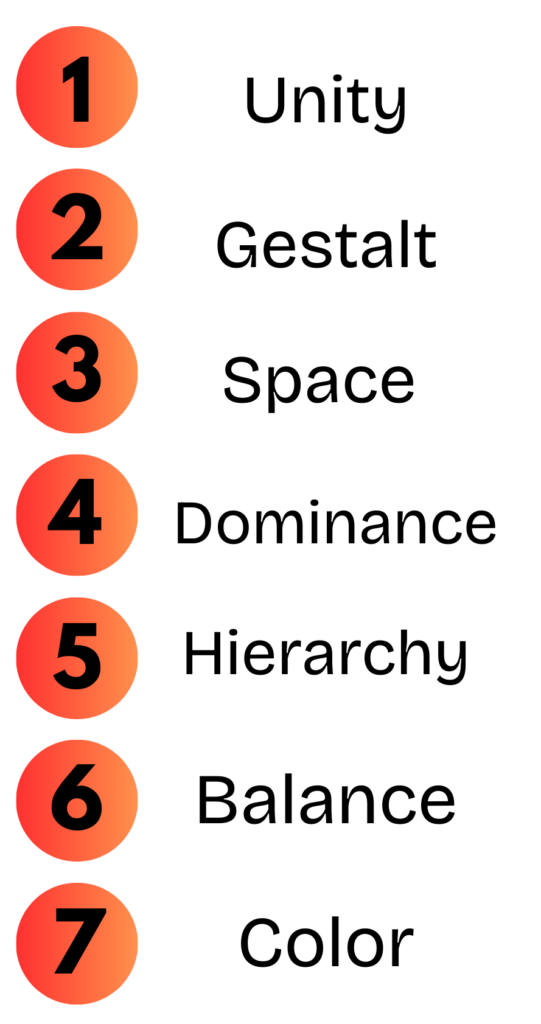
*(As you can tell from the graphic above, I still have a lot to learn)
Why Design Matters
I found this short video by The School of Life to be a relevant and interesting addition to this blog post. If you have a few minutes to spare, I recommend giving this a watch!
Summary & Reflection: The Vignelli Canon
As part of this assignment we were assigned the above booklet by the late Massimo Vignelli, a famous designer involved in graphic design, industrial design, furniture, and architecture. Here are my thoughts…
Vignelli opens by reminding the reader that the following “rules” he lays out aren’t meant to stifle imagination but rather provide a formula in which designers can build upon to better achieve their goals. As he says, “creativity needs the support of knowledge to be able to perform at its best.”
From there he explains three aspects of Design he finds most important:
Semantic
“Semantics, in design, means to understand the subject in all its aspects; to relate the subject to the sender and the receiver in such a way that it makes sense to both. It means to design something that has a meaning, that is not arbitrary, that has a reason for being, something in which every detail carries the meaning or has a precise purpose aimed at a precise target.” (pg. 11)
Syntactic
“The syntax of design is provided by many components in the nature of the project. In graphic design, for instance, they are the overall structure, the grid, the typefaces, the text and headlines, the illustrations, etc. (pg. 12)
Pragmatic
“Whatever we do, if not understood, fails to communicate and is wasted effort. We design things which we think are semantically correct and syntactically consistent but if, at the point of fruition, no one understands the result, or the meaning of all that effort, the entire work is useless.” (pg. 14)
For the rest of the chapter he shares even more parts of Design worth acknowledging (discipline, appropriateness, ambiguity, etc.) If you are interested in hearing more or seeing the accompanying illustrations, I recommend clicking the hyperlink The Vignelli Canon here or in the section heading.
In part two, Vignelli addresses “the tangibles” of Design: paper size, grid layouts, typeface, contrast, sequence, white space, texture, among other things. Frankly, there’s too much to try and summarize in this blog post, so I once again encourage you to check out the booklet if this sounds interesting!
Conclusion
As for my thoughts? I really enjoyed skimming through The Vignelli Canon and hearing what advice an accomplished veteran of the craft had to give about Design. It’s neat to see that there are many overlapping aspects of Design and other things I’m more experienced with, like photography — Which makes sense as design is sort of everything everywhere all at once (good movie by the way). I may not be great at design, but I certainly know more than when I started this blog post, so that’s a win!
-Blake 🙂
Pingback: DesignBlitz – Blake’s Peru Study Abroad Journal
Pingback: Unit Reflection: Intro to Design – Blake’s Peru Study Abroad Journal